
English2017
Английский для всех простым языком
Все времена — примеры и упражнения
Статья позволит вам попрактиковать все времена на английском языке.
Для начала посмотрите примеры спряжения предложения во всех временах.
Пример # 1
I was waiting for the bus when you called. Past Continuous
I will be waiting for the bus again this time tomorrow. Future Continuous
I have waited for the bus many times in my life. Present Perfect
I had waited for the bus before I took a taxi. Past Perfect
If the bus doesn’t come, I will have waited for the bus for no reason. Future Perfect
I have been waiting for the bus since 9 o’clock. Present Perfect Continuous
I had been waiting for the bus for an hour when it finally arrived. Past Perfect Continuous
By 10 o’clock, I will have been waiting for the bus for 45 minutes. Future Perfect Continuous
Have you decided to take the train? No, I’m going to take the bus. ‘Going to’ Future
В реальной разговорной и письменной речи сами носители языка используют семь из 12 английских времен, это:
Пример # 2
She visited London 3 years ago. Past Simple
She was visiting London when she met him. Past Continuous
She had visited London once before she moved to England. Past Perfect
She had been visiting London for a few days when she had to return home. Past Perfect Continuous
She will probably visit London next year. Future Simple
She will be visiting London this time next year. Future Continuous
She will have visited London 6 times by the end of this year. Future Perfect
By tomorrow morning, she will have been visiting London for five days. Future Perfect Continuous
Has she arranged her day trip tomorrow? Yes, she is visiting London with the guide. Present Continuous
Has she decide where to go next year? Yes, she is going to visit London again. ‘Going to’ Future
Упражнения на все времена
Упражнение # 1
Проспрягайте предложение во всех временах: I do the laundry.
I’m doing the laundry.
I was doing the laundry.
I will have been doing the laundry.
I’ll be doing the laundry.
I have done the laundry.
I had done the laundry.
I’ll have done the laundry.
I have been doing the laundry.
I had been doing the laundry.
Упражнение # 2
Поставьте глаголы в нужном времени.
1. At two o’clock I (go) to the supermarket,
2. I (drive) my car when I saw my friend and I said ‘hello’.
3. Tomorrow I (eat) sushi.
4. I (be) to Italy.
5. I (drive) home from work every day.
6. He is having trouble finishing the project.
7. When did you arrive home yesterday?
8. Have you had your dinner yet?
9. This restaurant has become very popular.
10. Doctors have discovered cures for many diseases.
Упражнение # 3
В каком времени указаны предложения?
1. I drive home from work every day.
2. What did you eat for dinner?
3. I’m driving from work.
4. My brother lives in Chicago.
5. I have never been to space.
6. We’re having a great time on vacation.
7. I’m thinking about taking a trip around the world.
8. I have travelled the world.
9. He will have been eating his pizza.
10. I was recording a class for Youtube when you called.
6. We’re having a great time on vacation. Present Continuous
7. I’m thinking about taking a trip around the world. Present Continuous
8. I have travelled the world. Present Perfect
9. He will have been eating his pizza. Future Perfect Continuous
10. I was recording a class for Youtube when you called. Past Continuous
Упражнение # 4
Упражнение # 5
В каком времени написаны эти предложения?
Упражнение # 6
Проспрягайте предложение: David closes the door.
17 thoughts on “ Все времена — примеры и упражнения ”
8. … you (have) your dinner jet?
She was waiting London when she met him. Past Continuous
Исправьте в вашей статье опечатки.
Упражнения на повторение времен (уровень СРЕДНИЙ — intermediate)
В данной статье вы найдете упражнения на повторение времен уровня intermediate. Упражнения содержат как простую, так и сложную лексику. Разделы, которые не вошли, можно повторить по тестам, которые к ним относятся — здесь Английская грамматика по уровням (уровень 2)
Содержание:
Упражнения на повторение времен (уровень intermediate)
Основные времена в английском языке. Таблица
Упражнение 1 (вводное). Раскройте скобки и поставьте глаголы в нужном времени.
My cousin’s name (be) Sylvie Dupont. She (live) in Paris and (work) in a cafe in the centre of the city. She (work) there for three years. At the moment her best friend from England (stay) with her. She (enjoy) her holiday very much. They (already/visit) many museums together and they (be) to the theatre three times. Last week they (see) a new film and then (have) dinner at a restaurant. Last Tuesday they (go) to a disco with some friends of theirs. They (not/come) home until late. Sylvie (be) very tired then.
Упражнение 2. Present Simple, Past Simple, Future Simple, Present Continuous, Present Perfect, Past Continuous, Past Perfect.
Упражнение 3. Раскройте скобки, употребляя глаголы в Present Perfect, Present Simple, Present Continuous, Past Simple или Past Continuous.
- 1.With whom you (to talk) yesterday? 2. I (to see) this film this week. I like it very much. 3. When I (to enter) the kitchen, I (to see) that my mother (to stand) at the table and (to cut) some cabbage. She (to cook) dinner. 4. They (to go) to the Hermitage last week. 5. They (to be) to the Hermitage twice this week. 6. Yesterday afternoon he (to come) home, (to have) dinner, (to read) an article from the latest magazine and (to begin) doing his homework. 7. When your friend (to return) from the south? — She (to return) yesterday. — You (to go) to the station to meet her? — No, I …, I (to be) too busy. 8. Your brother (to return) from the north? — Yes,… He (to come) back a few days ago. 9. You (to be) to the Crimea? When you (to be) there? — I (to be) there in 2005. 10. As soon as I (to see) him, I (to understand) that he (to work) hard. He (to write) something and (not to notice) anything. 11. When I (to come) home yesterday, the children (to run) and (to sing) merrily. «We (to learn) a new song!» they cried. 12. When I (to hear) a cry, I (to run) out of the room and (to see) that a child (to lie) on the ground and (to cry). «What (to happen)? Why you (to cry)? You (to hurt) yourself?» I asked.
Упражнение 4. Заполните пропуски словами yet, already, just, ago, since, for, how long.
Упражнение 5. Раскройте скобки, употребляя глаголы в Present Perfect, Present Simple, Present Continuous, Present Perfect Continuous.
Упражнение 6. Поставьте глаголы, данные в скобках, в нужном времени по смыслу.
Упражнение 7. Найдите ошибки и исправьте их.
Упражнение 8. Сопоставьте время глагола и характер действия.
Упражнение 9. Translate into English:
Упражнение 10. Translate into English:
Упражнения на Future Simple и условные предложения
Упражнение 11. Раскройте скобки, употребляя глаголы в нужном времени.
1.Before you (to cross) the park, you will come to a supermarket. 2. When you (to cross) the park, you will see the hospital. 3. If you (to translate) this article into Russian, I will use it in my report. 4. If you (not to hurry), you will miss the train. 5. If it (to rain), we won’t go to the country. 6. When my friend (to come) to St. Petersburg, we will go to the Russian Museum. 7. What will you be doing when he (to come) to your place? 8. I will be able to translate this article if you (to give) me a dictionary. 9. You will have to work hard at home if you (to miss) the lesson. 10. Where will you go when you (to come) to London? 11. The child won’t be healthy if you (not to give) him much fruit. 12. I won’t have dinner before mother (to come) home.
Упражнение 12. Раскройте скобки, употребляя глаголы в Present Simple или Future Simple. (Все предложения относятся к будущему.)
Упражнения на Passive Voice в Present Simple, Past Simple и Future Simple
Упражнение 13. Раскройте скобки, употребляя глаголы в пассивном залоге.
Упражнение 14. Замените действительный залог страдательным.
ПРИМЕР. Everybody laughed at the child. — The child was laughed at. (см. предложения *)
Упражнение 15. Замените действительный залог страдательным.
Упражнение 16. Найдите ошибки и исправьте их.
1.Who was made the report? 2. Who was founded the university? 3. What the film called? 4. When the world’s first film was shown? 5. Where the first European university situated? 6. When the first Moscow metro station built? 7. When Shakespeare wrote his plays? 8. How the bank robber arrested yesterday? 9. When you was born? 10. What is the dress make of?
Упражнение 17. Раскройте скобки, употребляя глаголы в Present Simple, Present Perfect, Past Simple, Future Simple. Используйте Активный и Пассивный залог.
Упражнения на перевод в разных временах
Упражнение 18. Переведите на английский язык.
Упражнение 19. Переведите на английский язык.
Упражнение 20. Переведите на английский язык.
Упражнение 21. Переведите на английский язык.
Вы выполнили упражнения на повторение времен (intermediate). Ответы даны ниже.
ОТВЕТЫ
Ответы доступны только для пользователей, оплативших подписку «ОТВЕТЫ».
Упражнения на времена в английском языке (с ответами и переводом)

Времена в английском языке – важная часть грамматики и камень преткновения начинающих. Чтобы не путаться во временах, просто изучить теорию не достаточно, нужно закрепить знания с помощью упражнений. Эти упражнения на времена в английском языке помогут вам лучше разобраться в одной из главных тем английской грамматики.
Если вы хотите освежить в памяти тему времен в английском языке, прежде чем проходить упражнения, посмотрите это видео, где я разбираю времена в активном залоге.
Упражнение 1. Глагол в Present Simple
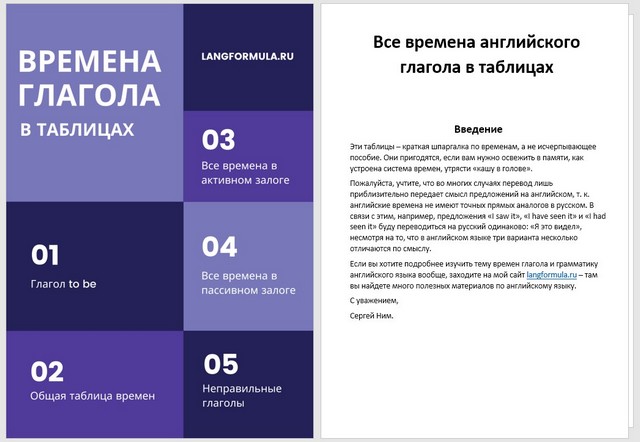 Этот справочник включает таблицы глагола to be, общие таблицы времен, таблицы по каждому времени в отдельности, включая пассивный залог, а также подборку неправильных глаголов
Упражнение 2. Неправильные глаголы
Неправильные глаголы отличаются тем, что образуют 2-ую и 3-ю формы нестандартным способом. Поставьте глаголы в нужную форму, какую именно – поймете из контекста.
Упражнение 3. Времена Continuous
В этом задании вам нужно раскрыть скобки и поставить глаголы в нужную видовременую форму: Present Continuous, Past Continuous или Future Continuous. Обращайте внимание на перевод, чтобы понять, какое выбрать время.
Упражнение 4. Present Simple или Present Continuous?
В английском языке существуют отдельные формы для неопределенного (простого) времени и длительного. Раскройте скобки и поставьте глагол в нужную форму – Present Simple или Present Continuous.
Упражнение 5. Времена Simple или Continuous?
Это упражнение на все времена Simple и Continous. Раскройте скобки и поставьте глагол в одну из форм:
1. You will be safe now. – Теперь вы будете в безопасности.
2. Yesterday I found a coin in the garden. It looked very old. – Вчера я нашел монету в саду. Она выглядела очень старой.
3. Jake was watching TV when someone knocked on the door. – Джейк смотрел телевизор, когда кто-то постучал в дверь.
4. Life is like a box of chocolates. You never know what you are going to get. – Жизнь – как коробка шоколадных конфет. Никогда не знаешь, что получишь.
5. We were just talking about you! – Мы только что о тебе говорили!
6. I can’t pick you up from the school today, because I will be working in the evening. Mom will pick you up. – Я не могу заехать за тобой в школу сегодня, потому что вечером буду на работе. Мама за тобой заедет.
Упражнение 6. Past Simple или Present Perfect?
Present Pefrect и Past Simple часто вызывают затруднения, поскольку во многих случаях переводятся на русский язык одинаково. Проверьте, знаете ли вы, в каких случаях используется Past Simple, а в каких Present Perfect.
Выберите правильный вариант перевода.
Упражнение 7. Времена Past Perfect и Future Perfect
Past Perfect чаще встречается в художественной литературе, чем в разговорной речи. Future Perfect используется редко и в устной речи, и в письменной. Знаете ли вы, в каких случаях используются эти времена?
Выберите правильный вариант перевода.
Упражнение 8. Времена в английском языке
В этом задании вам нужно раскрыть скобки и поставить глагол в видовременную форму, подходящую по смыслу. Обращайте внимание на перевод, чтобы понять, какое время глагола лучше подходит.

Здравствуйте! Меня зовут Сергей Ним, я автор этого сайта, а также книг, курсов, видеоуроков по английскому языку.