
Упражнение 48. Unit 5 Section 3 перевод Enjoy English 5-6 класс
Перевод:
Марк Твен, известный американский писатель, был известен как лектор. Литературные клубы часто приглашали его говорить. Перед одной из его лекций член клуба приехал к нему и сказал:
«Г-н Твен, люди говорят, что Вы можете рассказать очень забавные истории. 1 надежда, что во время Вашей лекции Вы расскажете историю, которая заставит моего дядю смеяться. Он не смеялся в течение десяти лет.»
«Я приложу все усилия. » Марк Твен сказал.
Когда он начал свою лекцию, Марк Твен заметил члена клуба. Он сидел перед ним со стариком, у которого было очень печальное лицо.
Марк Твен начал говорить шутки, один за другим. «Я сказал шутки легкого и короткие шутки, новые шутки и старые шутки,» сказал Марк Твен его друзьям. «Я сказал каждой шутке, что знал, и скоро все смеялись. Все — но не старик. Он смотрел на меня с холодом, голубыми глазами. Я не мог заставить его смеяться, и я попробовал еще раз и снова. Но ничто не помогло. «
После лекции член клуба приехал к Марку Твену и сказал, «Спасибо, г-н Твен. Я никогда не слышал столько забавных историй», «Они не были достаточно забавны для Вашего дяди. » Марк Твен ответил. «Он даже не улыбался.»
знайте, что» человек сказал. «Он не смеялся в течение десяти лет. Но P не говорил Вам, что он ничего не слышал в течение десяти лет. Он глухой. Перевод был взят с сайта spishy-online.ru
Оригинал:
Mark Twain, the famous American writer, was well-known as a lecturer. Literary clubs often invited him to speak. Before one of his lectures a club member came to him and said:
«Mr Twain, people say that you can tell very funny stories. 1 hope that during your lecture you will tell a story that will make my uncle laugh. He hasn’t laughed for ten years.»
«I will do my best.» Mark Twain said.
When he began his lecture, Mark Twain noticed the club member. He was sitting in front of him with an old man who had a very sad face.
Mark Twain began to tell jokes, one after another. «I told lung jokes and short jokes, new jokes and old jokes,» Mark Twain told his friends. «I told every joke I knew and soon everybody was laughing. Everybody — but not the old man. He was looking at me with cold, blue eyes. I couldn’t make him laugh, and I tried again and again. But nothing helped. «
After the lecture, the club member came to Mark Twain and said, «Thank you, Mr Twain. I have never heard so many funny stories» «They weren’t funny enough for your uncle.» Mark Twain answered. «He didn’t even smile.»
know» the man said. «He hasn’t laughed for ten years. But P didn’t tell you that he hadn’t heard anything for ten years. He is deaf.
Базовый курс английского языка. К.Э. Эккерсли
Соврененная русская версия.

Английские звуки. 6
Английский алфавит. 7
Урок 1. The First Essential Structures (1). 8
Урок 2. The First Essential Structures (2). 14
Грамматика. Глагол to be (настоящее время). 33
Грамматика. Простое настоящее время. 42
Урок 9. The Teacher and the Students (2). 50
Урок 12. The Teacher and the Students (3). 65
Урок 13. The Characters in the Essential English Books (1). 69
Грамматика. Вопросительные предложения в простом настоящем времени. 74
Урок 15. Discussion of Lesson 13. 77
Урок 17. The Characters in the Essential English Books (2). 89
Урок 19. The Characters in the Essential English Books (3). 98
Грамматика. Префиксы с отрицательным значением. 101
Урок 20. Frieda’s Family. 103
Урок 24. Comments on Lesson 23. 120
Грамматика. Вопросительная форма в простом прошедшем времени. 120
Отрицательная форма в простом прошедшем времени. 121
Урок 26. Irregular Verbs (1). 128
Урок 28. Irregular Verbs (2). 138
Урок 29. The Present Perfect Tense (1). 142
Урок 30. The Present Perfect Tense (2). 145
Грамматика. Разделительные вопросы (1). 146
Урок 31. The Present Perfect Tense (3). 149
Урок 32. The Present Perfect Tense (4). 151
Грамматика. Разделительные вопросы (2). 152
Грамматика. Прошедшее совершенное время. 161
Урок 7. Comments on Lesson 6. 180
Грамматика. Возвратные местоимения. 181
Грамматика. Собирательные существительные. 193
Грамматика. Формы настоящего времени в страдательном залоге. 245
Формы прошедшего времени в страдательном залоге. 245
Формы, будущего времени в страдательном залоге. 246
Урок 23. Back from the Holidays. 248
Урок 5. Direct and Indirect Speech (2). 318
Грамматика. Косвенные вопросы. 318
Команды в косвенной речи. 319
Урок 6. Mrs. Priestley Tells a Story and Mr. Priestley Puts Up a Hen-house 324
Урок 18. Some Strange, but Very Important Verbs. «The Specials» (1). 381
Грамматика. Место наречий в предложении. 399
Третье лицо единственного числа. 400
Урок 22. Olaf Writes a Letter from Oxford (1>. 405
Урок 24. Olafs Letter from Oxford (2). 418
Урок 7. Word Study: already, yet, still . 532
Урок 8. Great Britons (1): Charles Dickens (1). 538
Урок 9. Great Britons (1): Charles Dickens (2). 545
Идиоматический английский (3): Сравнение. 616
Урок 19. Word Order. 620
Работа с глаголом (17):/ш//. 632
Список имен и географических названий. 695
Список неправильных глаголов. 696
Грамматические и иные термины. 697
THE VOCABULARY OF EVERYDAY LIFE
 M r. P r i e s t 1e y: You all need the words and phrases we use to describe our daily ac tions, so suppose I tell you the things that I do, more or less, every day. By the way, which tense ought I use for that, Olaf?
0 1a f: I think you ought to use the Simple Present Tense.
M r. P r i e s t l e y: Why?
01a f: Because that is the tense generally used for actions that are «habitual» or repeated.
M r. P r i e s t l e y: Very good, Olaf, Now I’ll begin: I wake at about seven o’clock and that it is time for me to get up. I like a cold bath every morning, so I put on my dressing-gown and slip
pers and go to the bathroom. The water feels MR. PRESTLEY very cold on winter mornings, but I rub myself IN DRESSING- hard with the towel and soon I feel quite warm. GOWN AND Then I shave, brush my teeth and wash my SLIPPERS
face and go back to the bedroom to dress. I brush and comb my hair, take a clean handkerchief out of the drawer and go downstairs for breakfast at a quarter past eight. After breakfast I sit and read my morning paper and smoke a cigarette, or in the summer I have a walk round my garden. I go into my study at nine o’clock and meet my students there, and the day’s work begins. At twelve-thirty I have a break for lunch. I usually have this at home, but sometimes I go out for lunch and have a chat with my friends before beginning work again at two o’clock. I generally finish my work by about five o’clock. Then I have a cup of tea and a biscuit, and in summer I spend an hour or so in the garden and play a few games of tennis, or I go to the golf club and have a round of golf.
We have dinner about seven-thirty or eight o’clock, and then we sit and talk, listen to the wireless or look at tele vision, or Mrs. Priestley plays the piano. Sometimes, in the summer, we take out the car and go for a drive in the country; in the winter we go to the cinema or the theatre. But that is not often. I have a lot of work to do, and usually after dinner or supper I go to my study and read or write until twelve or one o’clock.
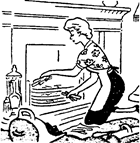 That’s my day. Now, here is Mrs. Priestley to describe a woman’s day. M r s. P r i e s t 1e y: I, too, get up soon after seven and go downstairs to help Susan with the work. She cleans out the stove and fills it up with coal, so that we get plenty of hot water all day. Than she takes out the ashes from the sitting-room fire and re-lays it with paper and sticks and coal. Then it is all ready
to light, and only needs a match put to it.
them up and order what I want by phone.
Then Susan and I go upstairs to make the beds, dust up stairs and downstairs, and do the carpets with electric-cleaner. It is about eleven o’clock by this time, so I change my clothes and begin to get ready for lunch. After lunch I do some sewing or go for a walk and visit my friends.
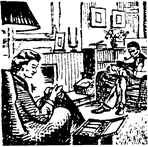 enough work for the day, and then he sits in his armchair at one side of the fire with his pipe and, for a change, a detective story. I sit on the other side with my book or my sewing; and Sally, our cat, lies on the carpet before the fire or jumps up on my husband’s knees. He is certainly Sally’s best friend, and wherever he is, in the house or in the garden, there you will find Sal
•E cp O H ET H 4E C K A TP E H H P O B K A
[I] [e] [] [A] [e1] [ K H E H H
I. Ilplf,lQ’MaiiTe npeAJI01KeHIDI co cJie,zzyrow;uMu CJIOBaMu:
| 1. slippers | 6. ashes | 11. butcher |
| 2. towel | 7. toast | 12. detective |
| 3. comb | 8. kettle | 13. knee |
| 4. rub | 9. honey | 14. blow |
| 5. stove | 10. dishes | 15. beat |
II. BcTaBbTe nponyw;euuwe CJIOBa B npeAJI01KeHIDI u3 ypoKa 3:
III. 06pa3yiiTe cJimK11ono,!l;’ln11e1111b1e npe;:um:HCe11uJ1, ucnoJib3YR CJIOBa
when, if, as HJIH because:
(1) I knocked at the door. Susan opened it.
(2) Mr. Priestley saw me. He came forward to meet me.
(3) We sat near the fire. The evening was cold.
(4) I was rather tired. I went to bed early.
(5) You are not warm enough. Put on the eiderdown.
(6) You can wash in your room. There is running water there.
(7) There are only the two of us. We have supper round the fire.
(8) The supper is over. My husband goes to the study to work.
(9) The wind is blowing through the trees outside. The fire seems very warm and comfortable.
(10) Sally is always with Mr. Priestley. He is her best friend.
1. HanumnTe OT 3-ro Jinu,a paccKa3bIua TeMh :a) )J,eHh M-paIlpncTJIH,
6) )J,ellb MHCCHC IlpnCTJIH.
2. HannmHTe paccKa3 o CBOeM )J.He.
3. CocTaBhTe paccKa3 no KapTHHKe ua cTp. 203.
4. CoquunTe paccKa3 «YTpo Xo6a» no KapTHHKaM ua cTp. 205. BaM no11a)J,06J1TCJ1 CJieiJ.YIOmue HOBbie CJIOBa: alarm-clock, dream (dream, dreamed, dreamt).
Hob wakes at eight o’clock in the morning, and gets up at half past eight. He does not have a cold bath; he just washes his hands and face and brushes his teeth, if he remembers. Then
he goes downstairs for breakfast. He eats lots of eggs and bacon and toast and he drinks three or four cups of coffee.
When he has finished breakfast, the day’s work begins. He walks round to Mr. Priestley’s house; he is often late. He shows Mr. Priestley his homework, if he has done any, and it is usu ally full of mistakes. He is glad when it is time for lunch.
For lunch Hob usually has roast beef and vegetables and after lunch he always has a cup of tea with lots of sugar in it. Sometimes he sits in armchair and reads the newspaper or a detective story, and sometimes, but not often, he does his work for Mr. Priestley.
In the evening after a tea of bread, butter, honey and cakes, Hob likes to watch television in front of a fire at Mr. Priest ley’s, or to visit other friends and tell them his funny stories.
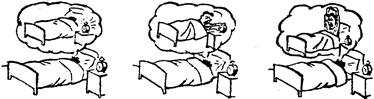
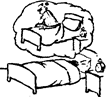
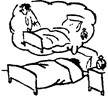
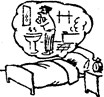
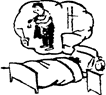
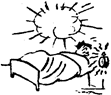
EARLY MORNING FOR HOB
LESSON 4

EVERYDAY TALK
Scene: Mr. Priestley’S study
Characters: Mr. Priestley, Jan, Frieda, Olaf, Lucille, Hob.
J a n: You know, sir, I find that most of the things that you want to know when you are first learning English are never in the books that teach you English.
M r. P r i e s t 1e y: Indeed? I’m sorry to hear that.
M r. P r i e s t 1e y: I think I know what you mean, but could you give us an example?
J a n: I mean «everyday talk»; for instance, what ought I to say when I am introduced to someone?
M r. P r i e s t 1e y: Oh, just, «How do you do?»
Ja n: And what does he answer?
M r. P ri e st l e y: «How do you do?»
Ja n: But it seems nonsense. I ask someone a question about his health and he doesn’t give me an answer; instead he asks me a question which I don’t answer.
J a n: Oh, yes, I’ve heard that; and what does he answer? M r. P r i e st 1e y: «Very well, thank you. How are you?» Ja n: And what do you say if you are not very well?
M r. P r i e s t 1e y: Just, «Not very well», or «Not too well». J a n: That’s good; it’s just what I wanted. By the way, do you say «Good day» when you meet someone? I’ve noticed
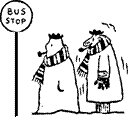 French and German people say it.
|
M r. P ri e st l e y: No. The things an English person generally says are, «Good morning», «Good afternoon» or «Good evening». If he is remark ing on the weather, he will probably say, «A nice day, isn’t it?» or, «A fine
i, day, isn’t it?» or «It’s cold today,
_ isn’t it?» or «Terrible weather we are TERRIBLE WEATERWE having, isn’t it?»; but that is not his ARE HAVING, ISN’T IT? greeting.
J a n: Don’t you say «Good night» in the evening?
M r. P r i e s t 1e y: Funnily enough we don’t when we are greeting a person, but only when he is leaving us or when we are leaving a shop or an office.
F r i e d a: There’s a small thing I want to ask about. There’s a little girl at the house where I am staying, and it is her birthday tomorrow. What shall I say to her?
M r. P r i e st 1e y: We say: «Many happy returns of the day». F r i e d a: Thank you; I’ll remember that. And how do peo
ple greet their friends at Christmas?
M r. P ri e s t 1e y: The usual greeting is, «A Merry Christ mas», and at the New Year we say, «A Happy New Year».
F r i e d a: And when someone says that to me, what do I answer?
M r. P r i e s t 1e y: «Thank you; the same to you».
01a f: I had a difficulty yesterday. I wanted to send a letter to a friend in London and a newspaper to one in Edinburgh, so I went to the post office and asked for a two-and-a-half stamp, for the letter and a one-and-a-half for the newspaper. The girl gave me the right stamps, but she smiled. What had I said wrong?
M r. P r i e s t l e y: You ought to have asked for a two-pen ny-halfpenny and a three-halfpenny stamp.
01a f: That’s difficult! And what money do I give for a three halfpenny stamp? Is it three halfpennies or a penny and half penny?
M r. P r i e st l e y: Well, we usually say three-half-pence, sometimes a penny-halfpenny. Just practise this, «A three-half penny stamp costs three-halfpence».
01a f: I see, and a twopenny stamp costs twopence, a three penny stamp costs threepence, and a three-halfpenny stamp costs three-halfpence.
L u c i 11e: A day or two ago I was talking with some people and I didn’t quite hear what one of them said to me, so I said «If you please?» That wasn’t right, was it?
M r. P r i e s t l e y: No; we say, «I beg your pardon», or, to a relation or close friend, «What?» or, «What’s that?» or, «What did you say?»
L u c i 11e: Couldn’t I say, «Pardon me?»
M r. P r i e s t l e y: No, never. If you are apologising for some little piece of impoliteness you say, «I beg your pardon», or nowadays, «Sorry» (which used to be thought slang). Ifyou
come late to the theatre and have to push past people who are already in their places, you say, «Excuse me».
H o b: I was out to tea a day or two ago and the hostess asked me if I wanted another piece of cake and of course I did, so I said «Thank you», but she didn’t seem to know whether I wanted it or not. I don’t want to run any risk of missing cake again, so what must I say?
M r. P r i e s t 1ey: «Thank you» in English may mean «Yes», but you had better say «Yes, please», then there can be no doubt. If by any chance you want to refuse, then you say «No, thank you».
01a f: I never quite know what to say when someone thanks me. For instance, yesterday I saw an old lady wanting to cross the road but afraid to start because of the traffic. So I took her arm and helped her across the road. Then she said, «Thank you very much. It was most kind of you to help me. Thank you». Do you know, I had no idea what to say.
F ri e d a: We say «bitte» or «bitte sehr» or «bitte schon». L u c i 11e: A Frenchman says «de rien» or «pas de quoi».
But what does an Englishman say?
M r. P r i e s t l e y: That’s difficult to answer. An English man in such a case looks rather confused and murmurs some thing like, «Not at all», «That’s all right» or «It’s a pleasure». And then quickly passes on to something else.
Y nP A >K HE HHSI
I.IlpH,ZiyManre npeAJIOlKeHIDI co CJieiIYIOIQHMH CJIOBaMU u BblJlalKeHIDIMll:
| 1. example | 4. birthday | 7. apologise |
| 2. weather 3. for instance | 5. by the way 6. health | 8. greeting 9. nonsense |
II. 0TBeTLTe ua CJieiIYIOrn:ue uonpocL1:
1. What do you say when you are introduced to someone? What does he answer?
2. What do you say if you are inquiring about his health?
3. What replies might you get to these inquiries?
4. What greeting would you give on meeting someone at (a) 10 a. m., (b) 3 p. m., (c) 6.30 p. m.?
5. Ifyou are remarking on the weather, what would you say?
6. When do you say «Good night»?
7. What do you say to a friend on his or her birthday?
8. What do you say at Christmas?
9. What reply do you get to that greeting?
10. How much does it cost to send (a) a newspaper,
(b) a postcard, (c) a letter, from London to Edinburgh?
11. What stamp do you put on (a) the newspaper, (b) the postcard, (c) the letter?
12. What do you say if you haven’t heard a remark and want the speaker to repeat it?
13. If you accidentally push a person, what do you say?
14. If your hostess asks you whether you want another cup of coffee, what do you say (a) if you want it, (b) if you don’t want it?
15. If someone thanks you, what do you say?
III. qTo 6h1 BhIMornu OTBeTHTh Ha CJie)JJ’IOII1ee:
1. «Oh! Mr. Green, this is Miss Brown».
3. «A Merry Christmas!»
4. «I’m twelve years old today».
5. «May I give you another cup of tea?»
6. «Do you prefer your coffee black or white?»
7. «Did you have a good journey?»
8. «I expect you are hungry after your long walk».
9. «How much is the newspaper?»
10. «Thank you very much for all your kindness».
Jan found that many things he wanted to know were not in the books that taught him English. When someone said, «How do you do?» to him, he did not know what to answer. It seemed to him nonsense just to ask another question instead of giving an answer.
Olaf had a difficulty, too. The girl in the post office smiled when he asked for a stamp. He ought to have asked for a twopenny-halfpenny one.
Frieda wanted to know about Christmas greetings. In Eng land we usually say «A Merry Christmas», and the answer is «Thank you. The same to you».
Hob didn’t ask anything. He didn’t even tell a funny story.
I expect he was asleep.
LESSON 5
PARTS OF SPEECH
M r. P r i e s t 1e y: There is a difference between «learning English» and «learning about English». Now I want you to learn English, and I believe the best way to learn to speak English is by speaking it; and that is why in our meetings, instead of talking to you about English grammar, I try to get you to talk about all kinds of things.
P e d r o: Excuse me, sir, but haven’t there been some new ideas in English grammar teaching about «structures» and «sen tence patterns»?
J a n: I want to learn some English grammar. F ri e d a and L u c i 11e: So do I.
01a f: I feel that my knowledge will be more solid if it has some grammar to help it.
All the words in the English language can be classified into eight groups, and only eight groups. They are divided accord ing to the work they do.
The kinds of words or «parts of speech» into which the the language can be divided are:
1. Words that are names of things, or people, or places: words like desk, aeroplane, happiness, glory, crowd, John, Lon don, Italy, navy.
These words are Nouns (Cyrn;ecTBiueJihHhie).
2. Words that tell us what a thing is like: words that we add
to a noun to make our meaning fuller or more exact, e. g. a good book, a fast train, six:1 boys, my friends.
These words we call Adjectives (IIpmrnraTeJibHbie).
3. Words that can be used instead of nouns so that we can refer to people or things without really naming them and so repeating the name too frequently: words like I, you, it, them, etc.
These words are Pronouns (MecTOJIMemrn).
4. Words that express an action or a state of being, e.g. I opened the door. Hob is asleep.
These words are Verbs (fnaroJibI).
5. Words that we can add to a verb to make the meaning fuller or more exact: words that tell us how, or when, or where an action takes place, e.g.
He ran quickly. I spoke to you yesterday. They lived there.
These words are Adverbs (HapeqJrn).
6. Words that are used with nouns (or pronouns), generally being placed in front2 of them, and show the relationship of this word to other parts of the sentence, e.g.
The ball went through the window. The dog sat under the table. He came here with me. I wrote to him.
These words are Prepositions (Ilpe)l)Iom).
7. Words that join together words, phrases or sentences,
The cat and the dog. He walked across the sand and into the sea. He worked hard but he did not get rich. He said that he worked because he liked it.
These words are Conjunctions (CoI03bI).
8. Words that express some sudden feeling causing an ex- clamation, e. g.
They do not enter into construction of the sentence. These words are Interjections (Me)l(,[(oMeTJrn).
There you have them all, and you can now put any word in the language into its right class. Remember, see what work it is doing in the sentence. I said, for example, that fast was an adjec tive. It was in the sentence that I used, «That is a fast train». But if I say,

1 06panne BHHMami:e, qTo B aHrJIHllCKOM BCe qJiCJIHTeJibHhle HMelOT cpyttKI\HIO, cxo;:vryro c cpyttKI(Heii: rrpHJiaraTeJI1>Horo.
2Ilpe)Jl!OfH, oco6eHHO B pa3roBope, qacTO CTOJIT B KOHIJ;e rrpe)JllO)[(eHHJI. HarrpHMep: What d d you do that for? What station do you want to go to?
I tell you how the train goes, i.e. how the action is done, and so in that sentence fast is an adverb.
Here are some further examples to show you that you must classify the part of speech by the work it is doing:
They fight very hard. ( Verb.)
They put up a grand fight yesterday. ( Noun.)
Try these exercises now to make sure you have understood this lesson.
Y nP A >K HE HHSI
I. YKIDKHTe, K KaKHM 11acTBM pe11u npuua,zJ,Jie.lKaT CJIOBa B 11,aunhIX npe)J,JIO.lKemrnx.
(a) Oh! I see that the new student from Norway reads and writes English well.
(b) Hello! Come with me tomorrow and see our new house.
II.IlpH11,yMaiiTe co6cTBenuh1e npe)J,JIO.lKeuuB, KOTOph1e TaK.lKe (KaK u B ynpa.lKHeuuu ) co11,ep.lKaJiu 6b1 Bee 11acrn pe11u.
III. YKa.lKHTe, K KaKoii 11acrn pe11u OTHOCBTCB Bhl)J,eJieuub1e CJIOBa.
ApryMeurnpyiiTe cBoii oTBeT.
1. I like spring flowers.
2. Spring is the first season of the year.
3. The cat springs on the mouse.
4.  The spring of my watch is broken.
5. The cat made a spring and caught the mouse.
6. Can you put a button on my coat?
7. I can’t button my coat; it is too tight.
8. I want you to copy these notes in your book.
9. Make a copy of these orders.
10. The child is going to cross
11. If you can’t write your name, put a cross (X).
12. Meet me at the cross-road s.
13. This is the Crown Prince of Ruritania.
14. He wears a crown on his head.
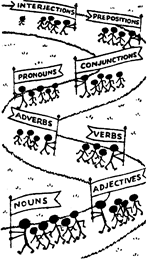
THE MARCH OF THE PARTS 15. They crown the kings of Eng-
OF SPEECH land in Westminster Abbey.
16. I have half-a-crown in my pocket.
17. I haven’t any doubt about the result.
18. I doubt whether you can do this work.
19. The boy is a very hard worker.
20. You must work hard.
21. That firm is a very good one.
22. He spoke in a firm voice.
23. The fly walked over the table and then began to fly round the room.
24. In Book 3 I will tell you a story of King Arthur and the Knights of the Round Table.
25. The pond is round.
26. The plane flew round the aerodrome.
27. Tum round and look at this picture.
28. I like to work in my garden; I do a lot of work there.
29. Get a hammer, and hammer in these nails.
30. He aimed a kick at the dog, but the dog was too quick.
31. «Don’t kick the dog», said John.
32. The ship has just come to land.
33. The passengers are going to land at Dover.
34. «There are land thieves and water thieves». (Shakespeare, Merchant of Venice.)
35. Give me a drink of water.
36. I am going to water the garden; it is very dry.
37. Lift the desk nearer the fire.
38. I came up in the lift.
39. March is the third month of the year, May is the fifth.
40. «March winds, April showers, Will bring May flowers». (Old Rhyme)
41. We watched the army march through the town.
42. The band played a quick march.
43. I may be able to come and see you soon.
44. I saw the flowers in Covent Garden Market.
45. It is a market day today.
46. They make cotton goods in Lancashire and market them all over the world.
47. I have some paint, some canvas and some paint brushes;
if only I had enough brains I could paint a good picture.
48. I am going to paper my bedroom.
49. The boy wore a paper hat.
50. Did you read the paper this morning?
51. He gave a shout for help; and as soon as I heard him
shout I ran to help him.
52. The wood is quite smooth.
53. I will try to smooth the difficulties out of your path.
54. It is beginning to snow now; the snow is quite thick.
55. The children will soon build a snow man.
56. Our telephone is out of order.
57. Telephone me if you want me; my address is in the
58. What is the use of having a thing if you can’t use it?
59. They paid us a visit last year; they visit us almost every year.
60. We always welcome their visit.
61. They gave me a very warm welcome in England.
62. There is some waste paper here.
63. Don’t waste your time and money. You know the proverb,
«Waste not, want not».
64. There is a lot of waste in a house where the wife is not a good housekeeper.
65. Watch me do this.
66. My watch is broken.
67. I wish I could go home. You will get your wish some day.
68. I hope you have understood this lesson now. If you haven’t, there is no hope for you.
LESSON 6
HOB TELLS A TRUE STORY
Mr. Priestley and the Students are in Mr. Priestley’s Study.
H o b: You were telling us about your cat, Sally, yesterday, Mr. Priestley, and you were saying what a wonderful cat she was. Now, I know a story, a true story, about a wonderful cat. May I tell it to you?
M r. P r i e s t 1e y: Well, if this story of yours is a true one, it will certainly be a change. Yes, let us hear it.
H o b: Oh, yes; it’s quite true. The cat, a black one named Pluto, belonged to my Aunt Aggie and she thought he was wonderful. If Aunt Aggie was doing anything, Pluto did the same. When she washed herself, the cat washed itself; when she looked at herself in the mirror, it looked at itself in the same mirror; if she talked to herself (as she sometimes did), the cat opened its mouth just like someone talking to himself. This gave Aggie an idea; she decided to try to teach Pluto to talk. (Aggie was always getting funny ideas.) She thought, «I’ll give Pluto the same food as I have myself; I’m sure that will help him to speak». And very soon the cat was sitting on a chair at the table and was eating bread and butter (cut thin), roast potatoes and Christmas pudding, and was drinking tea with sugar in it. One day I went to see Aunt Aggie, and there was Pluto. He was drinking coffee and was smoking a cigarette.
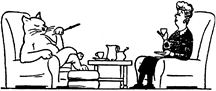
P e d r o: This is a true story that you are telling us, isn’t it, Hob?
H o b: I told you I was going to tell you a true story, didn’t I? You haven’t heard half of it yet.
Well, Pluto was certainly enjoying himself; in fact I think they were both enjoying themselves, but still he didn’t speak. Then Aggie had another idea; my family are always getting ide as. She had an old parrot that was always talking. It talked to itself, it talked to Aggie, it talked to Pluto. Aggie was get tired of this everlasting talk, so she thought to herself; «If Pluto eats the
 parrot, I’m sure he can’t help talking». So she killed the parrot, cooked it in butter (the best quality butter, she told me) and gave it, with fried potatoes and boiled cabbage, to Pluto. Pluto sat at the table and helped himself, very politely with a knife and fork, to the roast parrot, the fried potatoes and the cabbage, and he finished every bit of it. Then, suddenly he
turned to Aunt Aggie and shouted «Look out!»1Aunt Aggie was looking at him in such astonishment that she hardly noticed what he said, and the next moment a big piece of the ceiling fell down on her head. Pluto said, «She has spent five year getting me to talk, and then when I speak the fool doesn’t listen».
L u c i 11e: Oh. Hob, what a story!
H o b: What’s the matter? You believe it, don’t you?
L u c i 11e: Of course, I don’t; not one word of it. You don’t believe it yourself, do you?
H o b: Aunt Aggie told me the story herself, so, of course, I believe it, all except the bit about Pluto eating cabbage; I don’t think cats eat cabbage.
e. i. Y nP A >K HE HHSI
I. Ilplf,!Q’MaiiTe npe)J,JIO.lKeunH co cJiei:zyronMn CJIOBaMn:
1. wonderful; 2. true; 3. change; 4. same; 5. wash; 6. mirror;
7. decide; 8. funny; 9. enjoy; 10. cook; 11. quality; 12. fried;
13. politely; 14. astonishment; 15. ceiling.
II. BcTaBbTe npony:w;euuwe CJIOBa:
1 Look out 03HaqaeT Be on your guard, there’s danger; take care; something dangerous is happing. OcHOBHhre ll,[(llOMaTWiecKMe 3Haqemrn rnarona look rrpllBe,!l;eHhIB Kirnre IV.
III. YKIDKHTe, KaKoe u3 CJie)JJ’I0111,nx yrBep1K,11,enuu ucTunuo, a KaKoe JIO)K]IO.
1. A butcher is a man who sells bread.
2. We buy bread at the baker’s.
3. Seven and five is more than six and six.
4. In England the sun rises in the west and sets in the east.
5. There are only four seasons.
6. No month has less than thirty days in it.
7. The word there is pronounced the same as the word their.
8. The word week isn’t pronounced the same as the word
9. In every English dictionary there is at least one word that is spelled wrong.
10. White sheep eat more grass than black sheep.
COCTaBbTe paccKa3 (yCTHO HJIH DHCbMCHHO) 0 KOTe TCTH 3rru.
LESSON 7
KOMMEHTAPHH K YPOKY 6
(1) THE PAST CONTINUOUS TENSE
IlpoiueiJiuee npoiJo,11,J1Cennoe «peMR
BoT rrpMMepbI Ha 3TO BpeMJI M3 ypoKa:
Itold you Iwas going to tell a true story.
If Aunt Aggie was doing anything, Pluto did the same. Aggie was always getting funny ideas.
The cat was sitting on a chair and was eating bread and butter and was drinking tea.
Pluto was enjoying himself.
She had a parrot that was always talking.
She was getting tired of this everlasting talk.
He was drinking coffee and was smoking a cigarette. Aunt Aggie was looking at him in astonishment.
You were telling us about your cat.
You were saying what a wonderful cat she was.
3To BpeMJI o6pa3yeTCJI rrpM rroMOillM opMbI rrporne,D,rnero BpeMeHM rnarona to be M rrpacTMJI HaCTOJII11ero BpeMeHM. HIDKe rrpMBe,D,eHbI opMbI rrporne,D,rnero rrpo,D,oJDKeHHoro Bpe MeHM rnarona to go:
Past Continuous Tense
Iwas going We were going
You were going You were going He, she, it was going They were going
. «a car ran into bus»
Past Coninuous Simple Past
(iJeiicm«ue npoiJo,11,J1Caemca) (npoucxoiJum iJpywe iJeiicm«ue)
Aunt Aggie and Pluto when the ceiling
were eating their supper fell down on them
While he was having a lesson
If Aunt Aggie was doing anything While the man was
Hob went to sleep. Pluto did the same.
looking in the shop window the thief stole his watch. lf HOr)l,a qacnr rrpe)l,JI02Kemrn Moryr MeIDIThCH MecTaMM,
Simple Past Past Continuous
Hob went to sleep while he was having a lesson.
The thief stole the man’s watch while he was looking in the
The ceiling fell down
while Aunt Aggie and Pluto
were eating their supper.
(2) REFLEXIVE PRONOUNS AND EMPHASIZING PRONOUNS
Bo36pam11b1e MecmoUM e11UR
u ycU11ume.ab1tbte MecmoUM e11UR
06paTMre BHMMaHMe Ha CJie)lylOIIUle rrpe)l,Jlo2Kemrn: m ypoKa 6.
Pluto was enjoying himself.
When she washed herself, the cat washed itself.
Pluto helped himself to the food. They were both enjoying themselves.
When she looked at herself in the mirror, Pluto looked at
If she talked to herself, the cat opened its mouth as if it was talking to itself.
Aggie thought to herself.
Subject Verb Object
Pluto was enjoying himself
She washed herself
She talked to herself
He looked at himself
They were enjoying themselves The cat washed itself
B Ka)l()l;OM cnyqae )l,OIIOJIHeHMe HBJI5IeTcH TeM 2Ke JIMU:OM
(MJIM rrpe,ll,MeToM), qTQ M rro)l,Jle2Ka:rn:ee. Cy:w:ecTByeT pa3HMU:a B 3HaqeHMM Me)l()l;y:
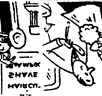
(a) The man shaved him.
(a) The man shaved him M (b) The man shaved himself.
IDIM (a) They fed them M
(b) They fed themselves.

(b) The man shaved himself.

JieHhl B CJie,n;yIOrn;Hx rrpe,n;JIOXeHHHX:
Ishaved myself this morning.
If you are not careful you will hurt yourself.
Jan taught himself French.
Lucille dressed herself carefully for the dance. One cannot always please oneself.
The little dog can feed itself.
We taught ourselves to swim.
Jan and Olaf enjoyed themselves in Scotland.
Ihope you all enjoy yourselves.
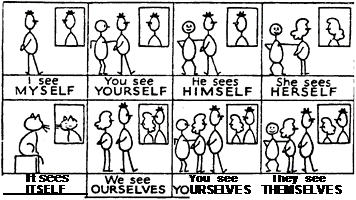
THE REFLEXIVE PRONOUNS
B ypoKe 6 HaM TaIOKe BCTpeTH.JIHCh rrpe,ll,.JIO)Kemrn: You don’t believe that story yourself.
Aunt Aggie told me the story herself
Iwill give Pluto the same food as Ihave myself
B 3THX rrpe,ll;JIO)Kemrnx MeCTOHMeHHH -self BhIIIOJIHHIOT
Subject Verb Object
You don’t believe that story
¢>ymcu;HeM HBJIHeTCH ycH.JieHHe, II03TOMY OHM H Ha3hIBaIOTC5I
yCH.JIHTeJibHbie MeCTOHMeHHH HHOr,r:i:a HMeIOT 3HaqeHHe
«CaM no ce6e». B 3TOM cnyqae HX corrpoBO)K,ll;aeT rrpe)])Ior by.
This is engine that goes by itself
The little girl travelled from London to New York all by
BOT Ta6Jim1a MeCTOHMeHHM -self (B03BpaTHhIX H ycIDIH TeJihHhIX):
1st person 2nd person
Singular myself yourself himself
Plural ourselves yourselves themselves
H o b: Ah! Now Iunderstand something that happened to me a short time ago.Iwent into the post office with a letter in one hand and a stamp that Ihad bought in the other, and
Ihanded them both to the girl there. «No, sir», she said, «You must stick the stamp on yourself ‘.
Icouldn’t believe my ears; Isaid, «Why must Istick the stamp on myself! It’s the letter that Iwant to post».
Isee now that Imade a fool of myself just because Ididn’t know the difference between a Reflexive Pronoun and a Em phasizing one!
B ypoKe (6) HaM BCTpenrnoc1> TPH 3Haqemrn 3Toro cnoBa:
(1) He helped himself to potatoes. «To help oneself» 3Haqm
 «to take», «to put food on one’s plate, to pour drink in one’s glass, etc». HarrpHMep: Help yourself to the cho
May I help myself to one
«Yes, there are plenty here; help yourselves, everybody.»
talking if he eats the parrot.
of your cigarettes? I have come without any.
(2) I’m sure he can’t help
3rn KOHCTpymmr (rro;::i:Jie)[(arn;ee H rnaron+repyH;::i:Hit) BCTPeqanac1> HaM B KHHre I. HarrpHMep:
Hob ( Subject) doesn’t like ( Verb) swimming ( Gerund).
|
Do they like learning?
(3) That will help him to speak.
cpOHET lll’IE C K A SI T PEHlllP O B K A

deal instance remark beg practise chance steal introduce return health slang pardon ceiling mirror risk mention stamp pass
refuse decide pleasure traffic card relation reflect parrot remark
across murmur fool murmur apologise astonish confused 1 return polite confused introdpce 1 [a1] instance introduce refuse fried mirror everlasting decide
case close halfpence hostess halfpenny post strange road
Y nP A >K HE HlllSI
II.II ocTaBbTe Bee rnaroJihIB CJie,ll,ylOIIIHX npe,ll,Jlo)KeHHHX B npome,11,mee npo,11,oJDKeuuoe BpeMH, npOH3BO,ll,H npu 3TOM ueOOXO,ll,HMhie H3MeueuHH:
2. Margaret is writting a letter.
I IlpOliI3HOCIITCH KaK LJU:].
3. We are listening to the music.
4. The singer is singing very well.
5. Jan and Olaf swam in the river.
6. Mr. Priestley has written a book.
7. The boys have worked very hard.
8. The gardener digs in the garden.
9. Jan will play football tomorrow.
10. They will look at the pictures next week.
III.I locTaBhTe marOJihIe CKOOKax e npome,!l,mee npo,!1,0JDKeuuoe epeMB:
1. Hob got off the bus while it (go).
2. Jan (walk) home when he saw Frieda.
3. I came into the room because the boys (make) a lot of noise.
4. Jan hurt his leg while he (play) football.
5. The car hit the tree while it (travel) at 60 miles an hour.
IV. 06pa3yi1Te npaBHJihHOe epeMH maroJIOB e cJie,!l,ylOll(HX npe,!l,JIO:lKe uuHX:
1. He (read) a book when I (see) him.
2. The cat (eat) its supper when the ceiling (fall) down.
3. We (sing) a song when Pedro (come) into the room.
4. While Mr. Priestley (give) a lesson, Sally the cat (jump) on his table.
5. When the phone bell (ring), I (work) in the garden.
6. The rain (begin) to fall while we (watch) the boys playing football.
7. I (see) some beautiful dresses in the shop window when I (come) to the class yesterday.
8. Just as I (get) interested in my work, I (have) to go home.
9. Mr. Priestley (write) that book while he (live) in Scotland.
10. As Hob (come) to the class he (buy) some cakes.
V. BcTaBhTe eo3epaTuh1e MeCTOHMeuuu:
VI. BcTaBLTe ycWIHTeJILHh e MecTonMeuus:
VII. BcTaBLTe cooTBeTcTeyro111ue B03BpaTnhle u ycuJinTeJILHLie MeCTOHMeHHB H o6’bBCHHTe CBOH Bbl6op:
2. He said he was not at the theatre but I saw him there-.
LESSON 8
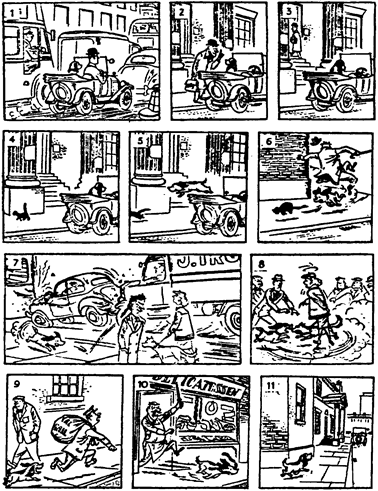
We have heard a lot about cats in this book, so here, for a change, is a story about a dog, a «story without words». The man here is Mr. Priestley’s brother, David, and his dog, Kim. David Priestley thinks Kim is the best dog in the world. He believes it is quiet and obedient, always behaves perfectly and couldn’t do anythin wrong. But, as you will see from these pictures, there is a lot that David doesn’t know. Let us look at the pictures.
Picture 1. Is David Priestley’s car a big one or a small one, a new one or an old one? Where is Kim sitting?
Picture 2. Mr. David Priestley is an insurance agent. He has to call and see people who want to insure themselves or their houses, and so on. He has stopped at the office because he has about an hour’s work to do before paying his first visit. He is leaving the dog in the car. What do you think he is saying to the dog?
Picture 3. Where is Mr. David Priestley now? Does Kim look a nice, quiet, obedient dog?
Pictures 4, 5, 6. You may find these words and phrases useful for describing these pictures: walk past, jump out, run after, round the comer, knock over, lose his hat.
Words and phrases for pictures 7 and 8
in front of a car, run into, bus, van, crash.
What has the car run into? What has the van run into? How did that happen; can you explain?
Where has the cat gone? Can you see it? But Kim has now seen a new enemy.
Does Kim look like a nice, quiet, obedient dog?
Picture 9. This man is a postman. The words on his bag are ROYAL MAIL. What will be inside the bag?
Picture 10. The word «delicatessen» over the shop is not an English word (neither is «cafe» but you can see these words quite often in England).
pork pie, ham, sausages, chicken
Can you describe the expression on the man’s face?
Picture 11. back again. Can you describe the expression on Kim’s face?
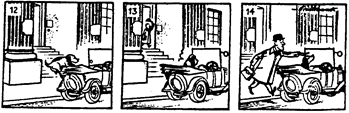
Pictures 12, 13. Mr. David Priestiey has been in the office for about an hour. Picture 13 is nearly the same as another one. Which? What is the only difference?
Picture 14. What is Mr. David Priestley doing now?
What do you think he is saying? Does Kim look like a nice, quiet, obedient dog?
Quiet (adj.)-quietly (adverb)-quietness (noun)
«Be quiet». «Keep quiet».
The little girl sat reading her book; she was as quiet as a mouse.
Mr. Priestley speaks quietly and dresses quietly in quiet colours. Mr. Priestley’s father enjoys a quiet old age.
Ienjoy the quietness of the country.
MhI qacTo ynoTpe6.JU£eM CJIOBO quiet KaK cynieCTBMTeJihHoe:
Ienjoy the peace and quiet of the country.
BuuMaHHe: pa3.JIJiqa:ii:Te cnoBa quiet [‘kwawt] (rnxMH.) M quite
Iwant you to be quite quiet for five minutes.
Kim sometimes obeys his master, and quite often disobeys
him. His master thinks he is always obedient; we saw that he could be disobedient. His master patted him on the head and praised him for his obedience. He didn’t know about his disobe dience.
A married man (and a single one, too) ought to insure his life.
Ihave insured my house against fire and robbery.
Mr. David Priestley is an insurance agent; he works in an insurance office. He tries to persuade people to take out an insurance on their lives and property.
IIpMJiaraTeJihHOe rrpoM3HOCMTCJI KaK [‘sep;mt] [‘sepnt] (OT
fnaroJI rrpOM3HOCMTC5I KaK [,sepGre1t] (pa3,JJ,e.JU£Th).
All the boys have separate bedrooms. Divide the money into three separate parts.
The man tried to separate the two dogs that were fighting. The English Channel separates England from France.
post ( verb and noun)-postman-post office-postcard-postage
I am going to post a letter.
Has the morning’s post arrived yet?
The postman has just brought some letters and a postcard.
I will ask at the post office what the postage is on a letter to Santiago.
Kim had a glorious hour.
There was a glorious sunset last night.
Shakespeare lived in the glorious days of Queen Elizabeth I.
In those days many men went away to win honour and
 All the people in the church sang «Glory to God in the Highest».
PaHee HaM BCTpeqa.rrocn CJIOBO pork (cmrn1rna). BoT e:rn:e cJioBa, o6o3Haqa10rn;Me pa3HOBM)J;HOCTM MHca:

lamb (young sheep) calf (young ox)
Maco (Meat) pork, bacon beef
Y nP A >K HE HHSI
I. Ilplf,ZQ’Maifre npe)J,JI01KennH co cJie;zyromnMn CJIOBaMn:
1. without; 2. quiet; 3. insure; 4. world; 5. obedient; 6. in surance; 7. believe; 8. obey; 9. separate (v.); 10. glory; 11. be have; 12. quite; 13. separate (adj.); 14. behaviour; 15. postage.
II. IlpH,ZJ,YMailTe npe)J,JI01KennH co cJie;zyromnMn cJiouoco’leTannHMn:
1. for a change; 2. in the world; 3. there is a lot; 4. before paying; 5. looks like; 6. jump out; 7. walk past; 8. run after;
9. corner of the house; 10. knock a man over; 11. in front of;
12. run into; 13. inside the bag; 14. in his mouth; 15. looks angry; 16. back again.
III. IlepecKa1KHTe (nnchMeuuo HJIH ycTHo) paccKa3 «3Be3hIH ‘lac».
LESSON 9
M r. P rie s t 1e y: In the examples I gave you of the noun in Lesson 5 there were desk, aeroplane, John, London, Italy, happiness, glory, crowd, navy. You perhaps feel that though all these names are similar because they are names of things, never theless there are differences. Thus, man and country can be used for all men and all countries, but John and Italy are names of particular persons or places.
Man, country, town are Common Nouns (Hap:iu.1,aTeJibHbie).
John, Italy, London are Proper Nouns (Co6crneHHbie). You will note that proper nouns begin with a capital letter;
common nouns, unless they are at the beginnig of a sentence, do not.
Again, words like happiness, whiteness, sweetness are not quite like boy, chalk, sugar. I can see and touch the happy boy, but hardly his happiness. I can put a spoonful of sugar in my tea but not a spoonful of sweetness. I can hold a piece of white chalk in my hand but I can’t hold the chalk in one hand and its whiteness in the other. The happiness, sweetness, whiteness have no existence apart from the boy, sugar, chalk:. they are qualities of these people or things; they are abstractions and so they are called Abstract Noun (A6cTpaKTHbie).
Finally we have words like crowd, navy, army, class. They are names of a group of collection of things, of men, ships, students, etc., but are regarded as one, so we speak of a crowd, a navy, an army, etc. These nouns are Collective Nouns. A collective noun is usually singular, and if we regard the thing that it represents as one whole, we use a singular verb with it. Sometimes, however, we regard the things or people that it represents not as one but as a number of separate people or things, e. g.
The football team is (singular) playing very well.
The singular is used because I am thinking of the team working as one whole together. But after the game is over I say: «The football team are (plural) having baths and are (plural)
coming back here for tea».
Because now I am thinking of the team as eleven different men having eleven baths and afterwards eating eleven teas.
The idea in my mind is a plural one, and so I use a plural verb.
 sheep is a flock < company. dogs >soldiers is a(n) regiment.
wolves 1 books is a library.
footballers, etc., is a team.
people in church is a congregation.
flowers or keys is a bunch.
flies2(or other insects) is a swarm.
rulers of a country is a government.
A people chosen to direct some work is a committee.
men who work a boat or ship is a e
cattle (cows, bulls, etc.) is a herd. ri J
battleships is a < fleet. L\
people is a crowd. Bunch of keys
people listening to music, a play, etc., is an audience. teachers of a school, officials, etc., is a staff. sticks is a bundle.
relations is a family.
people of the same origin is a race.
nations under one ruler is an empire.

tOLLECTlvt ABSTRllCT PROPER COMMON

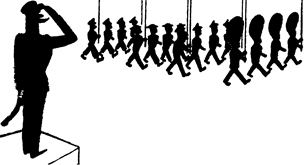
 1 EJJ:. qH:cno wolf.
THE MARCH OF THE NOUNS
Y n P A >K H E H IHI
I. Hail,!uue cymecTBHTMbHble u onpe)J;eJinTe ux Tun:
H. M. Stanley finds Dr. Livingstone 1
«I pushed back the crowd and, passing from the back, walked down between the lines of people until I came in front of the group of Africans where stood the white man with the grey beard. I wanted to run to him but I was a coward in the pres ence of such a crowd; I wanted to put my arms around him, only as he was an Englishman I did not know how he would receive me; so I did what cowardice and foolish pride suggested. I walked up to him and said, «Doctor Livingstone, I presume?»
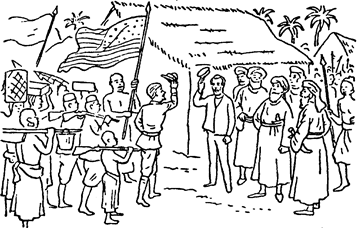
Doctor Livingstone, I presume?
TaKHM 1K.e o6pa3oM o6pa3yiiTe a6cTpaKTHb e cymecTBHTMbHb e oT:
1 David Livingstone, famous religious teacher and explorer, had gone into the heart of unknown Africa, and nothing had been hear of him for three years. Stanley, who himself afterwards became a great explorer but at this time was a newspaper man working for the New York Herald, was sent on the seemingly impossible task of finding him.
comfortable, happy, easy, true, various, present, courageous, ready, terrified, excited, hopeful, angry.
rnaronoB- believe, live, enjoy, oppose, lend, describe.