
Tourist attractions in Scotland – Достопримечательности Шотландии
Дорогой ученик! В этом материале опубликован рассказ про достопримечательности Шотландии. Под английским текстом есть перевод на русский язык. Мы подготовили описание 5 достопримечательностей.
Edinburgh Castle
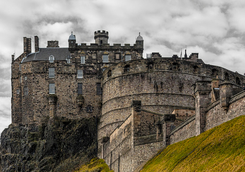
Edinburgh Castle is an ancient fortress which is located right in the centre of Edinburgh.
Edinburgh Castle is located on the Castle Rock, at the top of the Royal Mile.
The castle has a very good strategic position and can only be easily approached from one side. Nowadays, Edinburgh Castle is one of Scotland’s most popular tourist attractions.
The Royal Mile
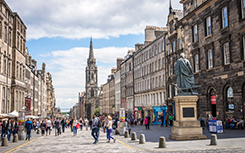
The Royal Mile is Edinburgh’s most famous street. It connects Edinburgh Castle with the Palace of Holyroodhouse.
It is home to parliaments old and new, law courts, a cathedral and churches, and a vast range of visitor attractions, walking tours, shops, restaurants, cafes and pubs.
Holyrood Palace
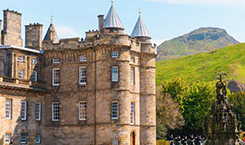
The Palace of Holyroodhouse is the official residence of the Monarchy in Scotland.
Today, the Palace is a close focus for national celebrations and events in Scotland, most notably The Queen’s ‘Holyrood Week’, which usually runs from the end of June to the beginning of July every year.
Loch Ness
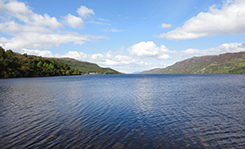
Loch Ness is a large, deep, freshwater loch in Scotland. Loch Ness is famous for the Loch Ness Monster, also known affectionately as «Nessie».
Loch Ness is the second largest Scottish loch by surface area after Loch Lomond, but due to its great depth, it is the largest by volume in the British Isles.
Ben Nevis
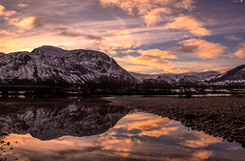
Ben Nevis is a mountain in the Scottish Highlands. It is the highest mountain in the British Isles. Its height is 1,344 metres.
Ben Nevis is a very popular tourist destination. The mountain is also of great interest to experienced climbers.
The summit of the mountain is a big plateau with an observatory, shelter and war memorial.
Примечание: этот текст частично переведен автоматическим переводчиком, поэтому в нем могут быть неточности и ошибки.
Достопримечательности Шотландии
Эдинбургский замок
Эдинбургский замок – это древняя крепость, расположенная прямо в центре Эдинбурга.
Эдинбургский замок находится на Замковой скале, прямо в конце Королевской Мили.
Замок занимает очень хорошее стратегическое положение, и подобраться к нему можно только с одной стороны. Сегодня Эдинбургский замок является одной из самых популярных туристических достопримечательностей Шотландии.
Королевская Миля
Королевская Миля – самая известная улица Эдинбурга. Она соединяет Эдинбургский замок с Холирудским дворцом.
Здесь расположены старый и новый парламенты, суды, собор и церкви, а также множество достопримечательностей, пешеходных экскурсий, магазинов, ресторанов, кафе и пабов.
Холирудский дворец
Холирудский дворец – это официальная резиденция монарха в Шотландии.
Сегодня дворец – это центр национальных праздников и мероприятий в Шотландии, в особенности «Холирудской недели», которая обычно каждый год проходит с конца июня до начала июля.
Лох-Несс
Лох-Несс – большое, глубокое пресноводное озеро в Шотландии. Лох-Несс больше всего известен Лох-несским чудовищем, которого ласково называют Несси.
Лох-Несс – второе по величине шотландское озеро по площади после озера Лох-Ломонд, но из-за большой глубины оно является крупнейшим по объему на Британских островах.
Бен-Невис
Бен-Невис – гора в Шотландском высокогорье. Это самая высокая гора Британских островов. Ее высота составляет 1,344 метра.
Бен-Невис – это очень популярный туристический маршрут. Гора также представляет большой интерес и для опытных альпинистов.
Вершина горы представляет собой большое плато с обсерваторией, убежищем и военным мемориалом.
Landmarks of the British Isles
методическая разработка по английскому языку (7 класс) по теме
средневековые замки Великобритании, а также современные достопримечательности в презентации,поворение гамматических навыков
Скачать:
Предварительный просмотр:
Тема урока: Развитие навыков говорения по теме «Достопримечательности Британских островов»
Тип урока: развитие всех видов речевой деятальности
-составить связное высказывание о событиях в прошлом;
-повторить образование и использование настоящих времен (Present Simple vs. Present Continuous)
-запрашивать и давать информацию
-развивать умения и навыки во всех видах речевой деятельности;
-развивать воображение в различных ситуациях общения;
-воспитывать интерес к культуре и истории стран изучаемого зыка.
Оборудование: компьютер, экран, проектор, мультимедийная презентация.
УМК: Учебник «Spotlight-7» Ю.Е. Ваулина, Дж. Дули, О.Е. Подоляко, Просвещение, 2010г.
Рабочая тетрадь, аудиоприложение.
Teacher. Good morning, children! I am glad to see you! Take your sits please! How are you doing? Let us start our lesson!
Teacher: Answer my questions, please!
-Do you like travelling?
-What we want to see while travelling?
-What kind of sightseeing in your country do you know?
-What kind of landmarks in the speaking-countries do you know?
-Do you know these sights? (слайды)
You are right, we are talking about landmarks of the UK. (слайды)
Look at the screen please, repeat after the speaker and write down in your vocabularies:
Teacher: Open your books on the page 11ex 1. Let’s listen to the text (аудиозапись).
Teacher: Now read the text and answer the questions:
-What is the capital of each country?
— What do you know about these countries?
Teacher: Let’s work in pairs. Think about one unusual fact about each place and tell the class. Compare with your partner.
Teacher: In groups ask and answer questions based on the text.
–Where’s Malahide Castle?
_ It’s north-east of Dublin City. Etc.
Teacher: Now you are ready to talk about landmarks of the British Isles. Tell your partner which castle you like and why.
Повторение образования и использования грамматических времен. (слайды)
Teacher: Open your diaries and write down your homework for the next lesson, please: workbook 1e
Teacher: What have you learned today? Your marks are…
Teacher: Do you like the lesson?
Well, thank you, that’s all for now! GOODBYE!
TEXT. THE BRITISH ISLESThe British
TEXT. THE BRITISH ISLES
The British Isles consist of two main islands: Great Brit¬ain and Ireland. These and over five hundred small islands are known collectively as the United Kingdom of Great Brit¬ain and Northern Ireland. Their total area is some 94, 250 square miles. Great Britain proper comprises Eng¬land, Wales and Scotland. The southern part of the isle of Ireland is the Irish Republic (or Eire).
Britain is comparatively small, but there is hardly a coun¬try in the world where such a variety of scenery can be found in so small a compass. There are wild desolate moun-tains in the northern Highlands of Scotland — the home of the deer and the eagle — that are as lonely as any in Norway. There are flat tulip fields round the Fens — a blaze of colour in spring, that would make you think you were in Hol¬land. Within a few miles of Manchester and Sheffield you can be in glorious heather-covered moors.
Once the. British Isles were part of the mainland of Eu¬rope — the nearest point is across the Strait of Dover, where the chalk cliffs of Britain are only twenty-two miles from those of France.
The seas round the British Isles are shallow. The North Sea is nowhere more than 600 feet deep, so that if St. Paul’s Cathedral were put down in any part of it some of the ca-thedral would still be above water. This shallowness is in some ways an advantage. Shallow water is warmer than deep water and helps to keep the shores from extreme cold. It is, too, the home of millions of fish, and more than a million tons are caught every year.
You have noticed on the map how deeply indented the coast line is. This indentation gives a good supply of splen¬did harbours for ships; and you will note, too, that owing to the shape of the country there is no point in it that is more than seventy miles from the sea — a fact that has greatly fa¬cilitated the export of manufactures and has made the En¬glish race a sea-loving one.
On the north-west the coasts are broken by high rocky cliffs. This is especially noticeable in north-west Scotland, where you have long winding inlets (called «lochs») and a great many islands. Western Scotland is fringed by the large island chain known as the Hebrides, and to the north east of the Scottish mainland are the Orkney and Shetland Islands.
In Scotland you have three distinct regions. There is, firstly, the Highlands, then there is the central plain or Low¬lands. Finally there are the southern uplands, «the Scott country,» with their gently rounded hills where the sheep wander. Here there are more sheep to the square mile than anywhere in the British Isles.
In England and Wales all the high land is in the west and north-west. The south-eastern plain reaches the west coast only at one or two places — at the Bristol Channel and by the mouths of the rivers Dee and Mersey.
In the north you find the Cheviots separating England from Scotland, the Pennines going down England like a backbone and the Cumbrian mountains оf thе Lake District, one of the loveliest (and the wettest) parts of England. In the west are the Cambrian mountains which occupy the greater part of Wales.
The south-eastern part of England is a low-lying land with gentle hills and a coast which is regular in outline, sandy or muddy, with occasional chalk cliffs, and inland a lovely pat¬tern of green and gold — for most of England’s wheat is grown here — and brown plough-land with pleasant farms and cottages in their midst. Its rich brown soil is deeply culti¬vated — much of it is under wheat; fruit-growing is exten¬sively carried on. A quarter of the sugar used in the country comes from sugar-beet grown there, but the most important crop is potatoes.
The position of the mountains naturally determined the direction and length of the rivers, and the longest rivers, ex¬cept the Severn and Clyde, flow into the North Sea, and even the Severn flows eastward or south-east for the greater part of its length.
The rivers of Britain are of no great value as water-ways — the longest, the Thames, is a little over 200 miles — and few of them are navigable except near the mouth for anything but the smaller vessels.
In the estuaries of the Thames, Mersey, Tyne, Clyde, Tay, Forth and Bristol Avon are some of the greatest ports.
(From «Essential English for Foreign Students» by C. E. Eckersley, Book 3, Lnd., 1997. Adapted)